Friday, March 13, 2009

African Americans and Pop Culture


Almost everybody will agree that the portrayal of African Americans in popular culture has come along way since the early 1900s. We no longer see true mistral shows and the traditional black-face that was common nearly a century ago would be seen as highly offensive and racist if it were shown on television or in films today. But there are those that argue that African Americans are still not treated as equals in today’s media and that the characters they portray in many popular programs and movies still conform, at least partially, to the stereotypes that were present in the early days of cinema and TV. According to Bensoff and Griffin, “Since American cinema for the most part functions under the dominant ideology of white patriarchal capitalism, it should not be surprising to discover that most popular film helps maintain dominant cultural attitudes toward African Americans.”

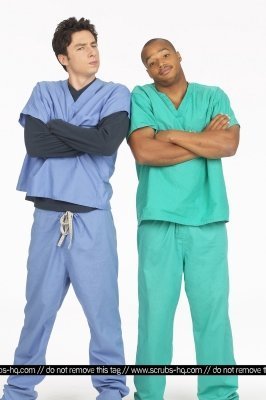
The popular television show “Scrubs” provides excellent examples of how race is portrayed in pop culture. The show’s format is very similar to the buddy films of the 1980s and early 90s. JD, the white male lead, and Turk, the Black male lead, are best friends and doctors who both work at a busy hospital. Much of the show’s plot centers on these two doctors and the situations they find themselves in. According to Bensoff and Griffin, these buddy films were popular “because the biracial casting of the lead roles makes the film appeal to both black and white audiences. Hollywood producers don’t want to finance a ‘black’ film unless they are sure it will also attract white audiences, which usually means the casting of a white star alongside a black one.” This clip shows that the producers of “Scrubs” see Turk as JD’s equal and best friend, and that they don’t generally conform to the African American stereotypes of earlier generations.

While Turk certainly isn’t a blatant example of a Black Buck or Uncle Tom character, some may argue that there are elements of a Coon character in Chris Turk. He often finds himself in silly situations which make him appear a little like a buffoon, such as the example in this clip. We see Turk acting like a child just for the sake of getting a laugh. However, the difference between Turk and the full-blown Coon characters of the 1930s and 40s is that JD is always acting silly right along with Turk, and in many cases his behavior is even more outrageous than Turk’s. However, this doesn’t change the fact that Turk is black, and much of the show’s humor relies upon him acting silly and childlike. This Coon stereotype becomes even more apparent in scenes, like the following, where Turk dances. These scenes further that the stereotype that African Americans are good dancers, and in so doing, may appear racist to some viewers.

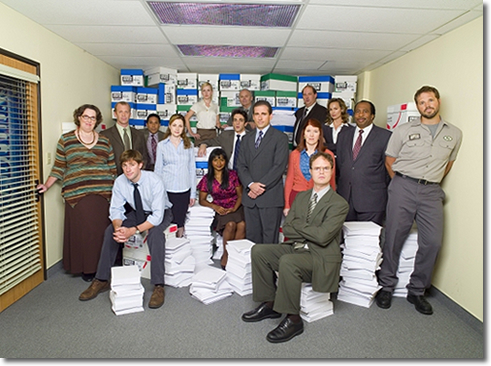
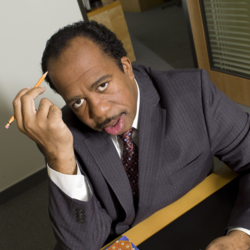
Another popular show that illustrates race in American media is “The Office.” While there are no minorities that are cast in leading roles in the show, Daryl and Stanely are two minor African American characters that have both been on the receiving end of Michael’s insensitivity. This clip shows Michael’s insensitivity toward other cultures in general, and the final scene where Michael tells Stanely, “We don’t call them ‘collared people.’ That would be offensive,” is a typical example of how Michael Scott treats African Americans. The humor lies not in stereotypes or the buddy format, but in just how racially insensitive Michael is. In order to understand the humor, the audience must realize that the way Michael treats African Americans and other ethnic groups is wrong and socially unacceptable. While this is much different than humor derived from racial stereotypes, it is definitely offensive to some, and may also show that there is still a disparity between how African Americans and Caucasians are treated in American media.
Sunday, February 22, 2009

Classic Films and Ideology


It is rare to find a list of the greatest films of all time that doesn’t include “The Godfather.” The film is considered to be a classic by almost everybody who’s seen it. So what does this tell us about our culture? In their text book “America on Film,” authors Harry Benshoff and Sean Griffin note that “cinema (and all other mass media) are important parts of American culture,” and that “culture is thus deeply connected to ideology: one might say it is the ‘real world’ manifestation of ideology, since characteristic features, social behaviors, and cultural products all convey ideology.” According to Benshoff and Griffin, because “The Godfather” is such a popular film, it has become part of our culture and through it we should be able to examine our ideologies.


One of the most dominant American ideologies, according to Benshoff and Griffin, is that of white patriarchal capitalism, or the belief that wealthy, white males are somehow superior in our society. This ideology can be seen very clearly in “The Godfather.” The film depicts a very powerful crime family in New York in the 1940s. There are no non-white characters in the film which serves to reinforce the association of whiteness to power. Race is never really an issue in the film because everybody is white.


We can also see that males are seen as the more powerful and privileged sex. In one of the more dramatic scenes in the movie, Michael Corleone’s sister Connie is beaten by her husband. Sonny, Michael and Connie’s other brother, hears of the beating and takes it upon himself to give Carlo a beating of his own. Not only can we see the male dominance in the actual fight between Carlo and Connie, the fact that Connie had to rely upon her brother to get even with Carlo reinforces the ideology that females are the weaker sex. This ideology is also illustrated in the final scene of “The Godfather.” We see Michael Corleone being addressed as “Godfather” by several of his associates while Kay, his wife, watches from another room. The fact that they are in separate rooms clearly shows the separation between the genders and at the end of the scene, the door is closed, shutting Kay out and providing more separation.


Another scene where we can see male dominance is when Don Corleone slaps Jonny Fontain and tells him to “act like a man.” By hitting Jonny and telling him he “cries like a woman,” he is again illustrating the ideology that males are the more powerful sex.


Capitalism is also explored in the film, although it is clearer in the second and third films than in the original “Godfather.” However in an important scene in “The Godfather” we can see that wealth is valued greatly in our society.


In this scene Don Corleone calls a meeting with the heads of the five crime families in New York. During the meeting Peter Tatalliga complains that Corleone “had all the judges and politicians in his pocket. He refused to share them.” We can infer not only that Don Corleone is one of the most respected and powerful men in New York, but that he is so respected because of his wealth. He was able to pay-off the legal system, paving the way for him to make even more money. The fact that all of the characters in this scene are obviously very powerful, and that they are all wealthy, white males further shows the white patriarchal capitalist ideology. The Corleone family’s wealth is also apparent in scenes where we see their mansion. It is enormous and is a symbol of great power.


So we can see that a film such as “The Godfather” that is such a powerful part of American popular culture can serve to illustrate some of our society’s dominant ideologies. And because it is so powerful, these ideologies are reinforced rather than challenged, which shows just how powerful the media is.

Thursday, January 29, 2009

"The Office" and Gender

“The Office” is easily one of the most popular shows on television today. Part of its popularity is due to the sometimes uncomfortable jokes and situations that arise out of Michael Scott’s incompetence and insensitivity. These awkward moments often involve sexual orientation or race, but gender is also a topic that is explored by Michael and his staff.

“The Office” does its part to perpetuate gender stereotypes, but it also shows us how traditional gender roles are changing. And the fact that we, as an audience, are able to laugh at Michael’s total lack of sensitivity towards gender issues shows that, as a society we are able to recognize inappropriate behavior and can find humor in its awkwardness.

Viewers of “The Office” are probably most familiar with gender issues through Michael’s sexist “that’s what she said” jokes, which has been a recurring theme throughout the series. Michael’s use of this junior-high school type joke is generally quite inappropriate for typical work place environments, and they tend to portray women as sexual objects.


While jokes like these tend to be more in line with how gender was viewed in the past, “The Office” doesn’t necessarily view women in this out-dated sense all of the time. According to David Gauntlett in his text Media, Gender and Identity: An Introduction, in the past, “Female characters were unlikely to work, especially not if they were wives or mothers, and even when they did this work was not typically seen on screen” (47). However, the main setting of “The Office” is a work environment, and several women are portrayed. Phyllis, Meredith, Pam, Kelley and Angela are all portrayed as working women. It is interesting that of these women, only Meredith has children. And not only are these women shown in a work setting, some of them are shown to have more authority than men, a view of gender which would not have been shown in earlier decades. In the first few seasons, Michael’s superior, was Jan, who was portrayed as a smart business woman, and Angela is the head of the accounting department. However, Pam is the receptionist, a traditionally female role.

“The Office” also includes Oscar, an accountant who is openly gay. According to Gauntlett, “For years, lesbians and gays were invisible, and even now . . . these instances are exceptional and the majority of TV programs have featured and continue to feature, a seemingly all-straight set of characters” (92). While “The Office” includes a homosexual character, viewers who have not seen the episode in which Oscar “comes out” may not realize that he is gay, and Gauntlett and other media scholars may still see him as “invisible.”

Toby is also an interesting character to study in terms of gender roles. Toby is a divorced single-father, which is a role that men do not normally play in television sitcoms. In the past, “men were more likely to be assertive (or aggressive), whilst women were much more likely to be passive,” according to Gauntlett (47). However, Toby is a very passive character and not assertive at all. He rarely gets angry or emotional, and the rare occasion when Toby did show anger, it was a surprise to many viewers.


Although we can see that gender roles in “The Office” have not conformed to some of the stereotypes seen in television from earlier decades, we can see that some of these views of gender still exist. The most prevalent example is the separation of the warehouse workers and the office workers. Most of the characters that work in the warehouse on “The Office” are males, because this is a traditionally male job. It requires heavy lifting and manual labor, which conforms to the stereotype of a male job.

We can see that “The Office” conforms to many of the stereotypes of gender that have been perpetuated in the media for decades, however the show’s writers do this mainly for comic effect. The fact that the audience is able to laugh at the uncomfortable situations created by these out-dated stereotypes shows that we recognize that gender roles and stereotypes are changing and will continue to do so.